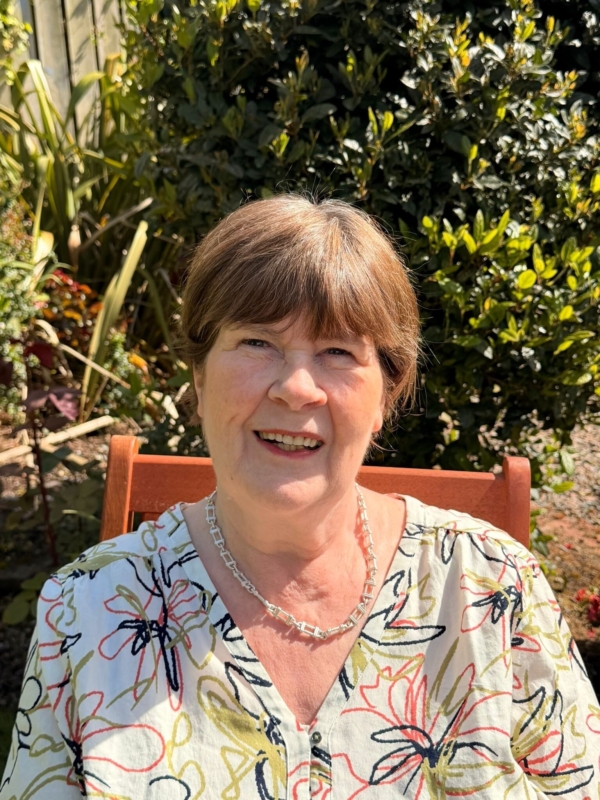
Every Tuesday Gail Agar, 65, from Comber gives up her time to help others, volunteering at our local Post Rehab Exercise Programme group. Gail knows all too well how much NICHS can help people post stroke as she needed their support after having a severe life-threatening and life-changing stroke eighteen months ago. This Volunteers’ Week (1-7 June) Gail is sharing her story and how it has led her on a path of helping others.
Gail recalls; “I had my stroke in November 2024. I had no symptoms, no warning signs and when the stroke hit, every part of my body was affected. I was at home and I just collapsed out of nowhere. My husband found me lying on my back with blood coming out of my head. He phoned 999 and within eight minutes a Paramedic in a Rapid Response Vehicle arrived. Two minutes later the ambulance arrived with three Paramedics. The Air Ambulance had also been called by the Rapid Response Paramedic, and it arrived a few minutes later. The Air Ambulance doctor advised my husband that he thought I had suffered a brain related incident. I was placed into an induced coma and airlifted to the Royal Victoria Hospital.”
At the hospital it was discovered Gail had a ruptured brain aneurysm. She was transferred to Critical Care where she was ventilated, had a feeding tube and catheter put in, and needed nursing care 24/7. Gail explains; “The next morning I had surgery to put a stent and coiling in to stop the bleed on my brain. The day after that the sedation started to be withdrawn and a few days later, I was transferred to Neurology. I can't remember any of that time. By the beginning of December the nurses started to feed me with thickened water on a spoon, but I couldn't talk because my vocal cords had been damaged by the ventilator. I was trying desperately to talk but no words would come out.”
“A few weeks later I was transferred to the Ulster Hospital where I began my rehab journey. I started physio as my left hand was completely paralysed and was in a fist. I also had to start to relearn how to walk. I started by standing for a while, then I moved on to shuffling and pulling myself along on a walking frame. Winning the lottery wouldn’t give you the same feeling I got when I started to be able to move again. It was unbelievable that I had actually done it as it took such enormous effort, and I had been told there was a possibility I might not walk again.”
At the start of January 2025 Gail was transferred to the Regional Acquired Brain Injury Unit (RABIU) at Musgrave Park Hospital in Belfast to continue with intensive rehabilitation. “It was daunting as by that stage I was more aware of everything, but I didn’t know what I was going to and I really just wanted to go home. From the moment I arrived at RABIU I was tested and assessed to see what the damage to my brain had been. I asked the doctor when I would get home and was told hopefully within five weeks. I was glad to hear that because then I had something to work towards. Up until then I was thinking, ‘will I ever got home. What is the end result here?’.”
“It was very intense, hard work every day but the staff at RABIU saved my life, there's no doubt. They knew how far to push me and when to slow down but it was tough. I had to learn everything again, even things like going to the toilet after the catheter was removed as that had all been wiped from my brain. I had to have pureed food, nothing I could choke on. After about two or three nights I said to myself, ‘it's only you who can do this, nobody else can’. I had to make the effort, and I had to do what they were telling me because they knew what they were talking about. But it was hard.”
Gail continues; “It was at RABIU I realised how severe my stroke had been. A student doctor from Queen’s University chose my case for his PhD topic. I asked him one day why he had picked me and he said ‘because there are very few people who have gone through what you have that we can talk to or watch and assess their recovery journey. It helps us with research and to better understand the brain’. It hit me then that I was lucky to be alive and to be working on my recovery.”
“I worked hard and on the 5th of February 2025, after months in hospital, I walked out of RABIU with no stick, no walking frame, no wheelchair, nothing. I had come a long way from nearly not making it in the Air Ambulance. I couldn't wait to get home but that is also when you realise how ill you have been and that the recovery journey isn’t over yet. In my mind, once I got home, I was going to be ok but there was still a long way to go. You realise when you come home how scary it is because you are starting to live a completely different life.”
“Your confidence has gone, people don’t really understand what it’s like, you always have to be aware of your surroundings in case there are trip hazards, you are always on the alert. You have to relearn to do things that you never gave a second thought, like going to the supermarket. The first time I tried to go to Tesco I just stayed in the doorway. It was too busy, there was trolleys coming at me, it was too much. But you have to go away, take a deep breath, set a date and go back and do these sorts of things because if you don’t, you never will. Over the first few weeks I had to set goals each week, like make a hair appointment, get my nails done, go to the dentist. Setting a goal helped me start to build my confidence up again and I started to feel like I was belonging to normal life again.”
Gail’s physical recovery continued after she was discharged from RABIU and that’s how she came into contact with Northern Ireland Chest Heart & Stroke (NICHS). “The Community Stroke Team did therapy at home with me for ten weeks, sometimes twice a day. They told me about NICHS and their services and support, but I wasn’t sure about going to anything at that point because I had got to a stage where I just wanted to live a ‘normal’ life. It had all been so intense for months with so many people treating me, appointments at Musgrave and so on. The more I thought about it however the more I thought, ‘no. I swore to myself that whatever help was offered I would take it’. I didn’t want to look back in 10 years’ time and think I might have been in a better place if I’d done everything that was offered to me.”
Gail started going to the charity’s Post Rehab Exercise Programme (PREP). PREP is a 6-week physiotherapy led, community-based course which helps rebuild people's lives after stroke through exercise and education. It is designed for stroke survivors who have completed the statutory rehabilitation provided by the NHS to meet their longer-term care needs. She says; “I really enjoyed PREP as soon as I started going because everybody was in a similar situation to me. Everybody was friendly and got along. The group was glad if you achieved something and were doing well. There is real camaraderie at PREP. We were also able to share hints and tips with each other about living with a stroke and find new ways to do things like getting dressed more easily. You are part of a group that understand what you were feeling whereas family and friends, as great as they are, can’t. That really helped me with the mental impact of my stroke.”
“I completed two rounds of PREP. I liked that all the exercises were counted and monitored, and you could see your progress. That helped keep me motivated with my recovery as I could see my efforts were being rewarded and I was moving forward. I also found the NICHS staff very approachable and helpful and they made the time to listen.”
“I was sad at the thought of my time at PREP ending after 12 weeks, so I asked the group’s Care Services Coordinator, Kyle, about coming back to help and volunteer. I thought I might be able to help others due to my experiences. I found PREP so beneficial I wanted to help others experience that too, to show people there is hope for a recovery, things can get better, and not to give up.”
“That’s why I’m also happy to share my story. If it helps show people you can get through having a stroke, if it gives some small flicker of hope, I feel going through this and telling my story will have been worth it. In the early days, when I was being told it wasn’t clear if I would walk or talk again, when I had a catheter in and so on, I did think, ‘what is the point of this?’ Why have I survived this, when it looked like I might not, because there is no hope here.’ I didn’t know enough about stroke and if I had seen a story like mine out there then I would have known things could get better.”
Talking about what she gets out of volunteering Gail says; “PREP is the focus of my week. Tuesday is PREP day and everything else just has to work around that. I really enjoy it and I like seeing all the clients and other volunteers.”
“When people first come to PREP, they might be scared, feel lost and that they don't know what is ahead of them. I understand what that’s like and I’m glad if I can help. It also reminds me how lucky I have been with my recovery; things could be a lot worse.”
“It is unbelievable to see how far people come in the six weeks at PREP, the hard work they put in and the effort, it is really noticeable. You can see the clients are really working hard, making improvements, and how they are happier because of that. It’s great to be a part of that. I would really encourage people to think about volunteering if they are able. You will get so much out of it.”
Gail concludes; “In a strange way I'm glad that my stroke happened. I've learnt an awful lot about myself. I think things sometimes happen for a reason and I've learnt I’m stronger than I thought I was. I appreciate things now that I didn't before. I wouldn't have met all the people at PREP that I have. There are positives that have come from this, and I hold on to the fact things could be a lot worse. I was dealt a bad hand, but I’ve played it the best way I could, I've come through it and I’m thankful for that.”
Caoimhe Devlin, Head of HR and Volunteering at Northern Ireland Chest Heart & Stroke says; “We are so grateful for all the help and support Gail gives to our charity and we would like to take this opportunity to thank her, and all our other volunteers this Volunteers’ Week.”
“At NICHS we depend on the support of our team of committed and compassionate volunteers to allow us to deliver our charitable activities. We involve volunteers in our care services, public health activities, research committees, on our Governance Board, at our fundraising events and as community ambassadors. In short, we involve volunteers in everything we do, and we could not achieve what we do without them.”
“We are currently recruiting for volunteer opportunities across Northern Ireland. Volunteering with NICHS really will make a profound difference to the lives of local people and anyone interested in being part of this can find out more at www.nichs.org.uk/volunteering .”
If you have been inspired by Gail’s story you can view NICHS’s current volunteer opportunities at www.nichs.org.uk/volunteering